
Why doesn’t God do something? Why doesn’t God end all the suffering? And, if he’s so good and so powerful, why won’t he come and sort things out? Why is he far off?
This isn’t just the question for your average Aussie. The same questions tormented God’s people, the ancient Jews. And their heartache was even sharper for God, or Yahweh, as they knew him, had acted in the past. He had protected Abraham, Isaac & Jacob. He had rescued their descendants out of Egypt from 400 years of slavery. And so they knew God was powerful. He could rescue.
But at various times God seemed far away. He had rescued in the past, so why wasn’t he doing anything now? He seemed to have deserted them in their greatest need.
It is a burning question: Is God, the creator of the universe, good? Or is he indifferent? Or worse, malignant? I’ve had plenty of reasons in my life to ask this question: ongoing hidden pain, my Dad’s death by suicide, and my son’s cancer and death. I know I’m not alone in this. Every person I’ve met and talked with deeply has had deep suffering rippling through their lives. Without exception.
So, if the quantity of suffering is so vast, and the quality of the suffering is so deep, does God care? From events in our lives and events in the world, it makes perfect sense to answer “No.” The verdict is in: God does not care. There is too much evidence of his indifference or even his malignancy. Except.
Except for the death of Jesus on the Cross
Except for the death of Jesus on the Cross. The death of Jesus on the cross asserts something so incredible and wonderful that we have to grapple with it. The death of Jesus on the cross asserts that God himself knows suffering. And not in some abstract form, but that he, the creator of the universe, experienced suffering. Somehow.
It is a profound mystery that the Creator himself, holy, perfect, and utterly powerful, would allow himself to suffer. No, more than allowed. He chose for himself suffering. For suffering comes from what is evil, twisted, and weak. Suffering arises from failure and brokenness. Whether it is broken justice, which at the national level leads to war and civil war. Or, broken bodies that don’t function as they ought, which leads to illness, things like cancer, and eventually death. Suffering arises from what is wrong. And Christianity asserts that God experienced this wrongness intimately.
And so we have poems like Jesus of the Scars by Edward Shillito. He was a Free Church minister in England at the time of World War 1. One of the lines that speaks deeply to me is this: ‘Show us thy scars, we know the countersign.’
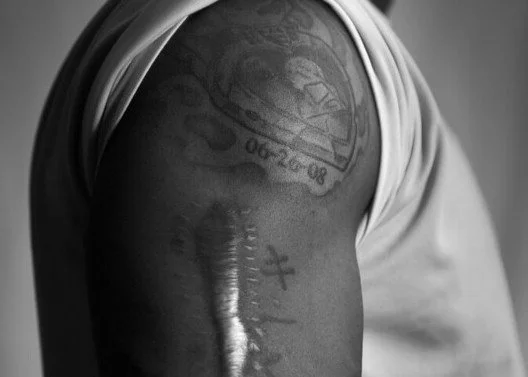
In one powerful line, the poet has captured the reality of our lives. They are riven with suffering. We have the scars. Scars on our bodies, scars in our minds, scars on our hearts, and even scars on our souls. But God knows scars, too.
“Jesus of the Scars” by Edward Shillito
If we have never sought, we seek Thee now;
Thine eyes burn through the dark, our only stars;
We must have sight of thorn-pricks on Thy brow,
We must have Thee, O Jesus of the Scars.
The heavens frighten us; they are too calm;
In all the universe we have no place.
Our wounds are hurting us; where is the balm?
Lord Jesus, by Thy Scars, we claim Thy grace.
If, when the doors are shut, Thou drawest near,
Only reveal those hands, that side of Thine;
We know to-day what wounds are, have no fear,
Show us Thy Scars, we know the countersign.
The other gods were strong; but Thou wast weak;
They rode, but Thou didst stumble to a throne;
But to our wounds only God’s wounds can speak,
And not a god has wounds, but Thou alone.
The message is this: God, in the person of Jesus, entered into our suffering. He knows it.
But we need to ask why? Why would he do that? We hate suffering. Why would God enter into suffering?
Why would God enter into our suffering?
He suffered so that he might fix the source of all the suffering in the world: sin. Here is how an Old Testament prophet named Isaiah captured this truth.
‘But he was pierced for our transgressions, he was crushed for our iniquities; the punishment that brought us peace was on him, and by his wounds we are healed.
We all, like sheep, have gone astray, each of us has turned to our own way; and the LORD has laid on him the iniquity of us all.’
Jesus’ scars speak to us in our need. God knows our suffering and has proven his love and his care for us on the Cross. He entered into suffering so that he might conquer sin and suffering forever.